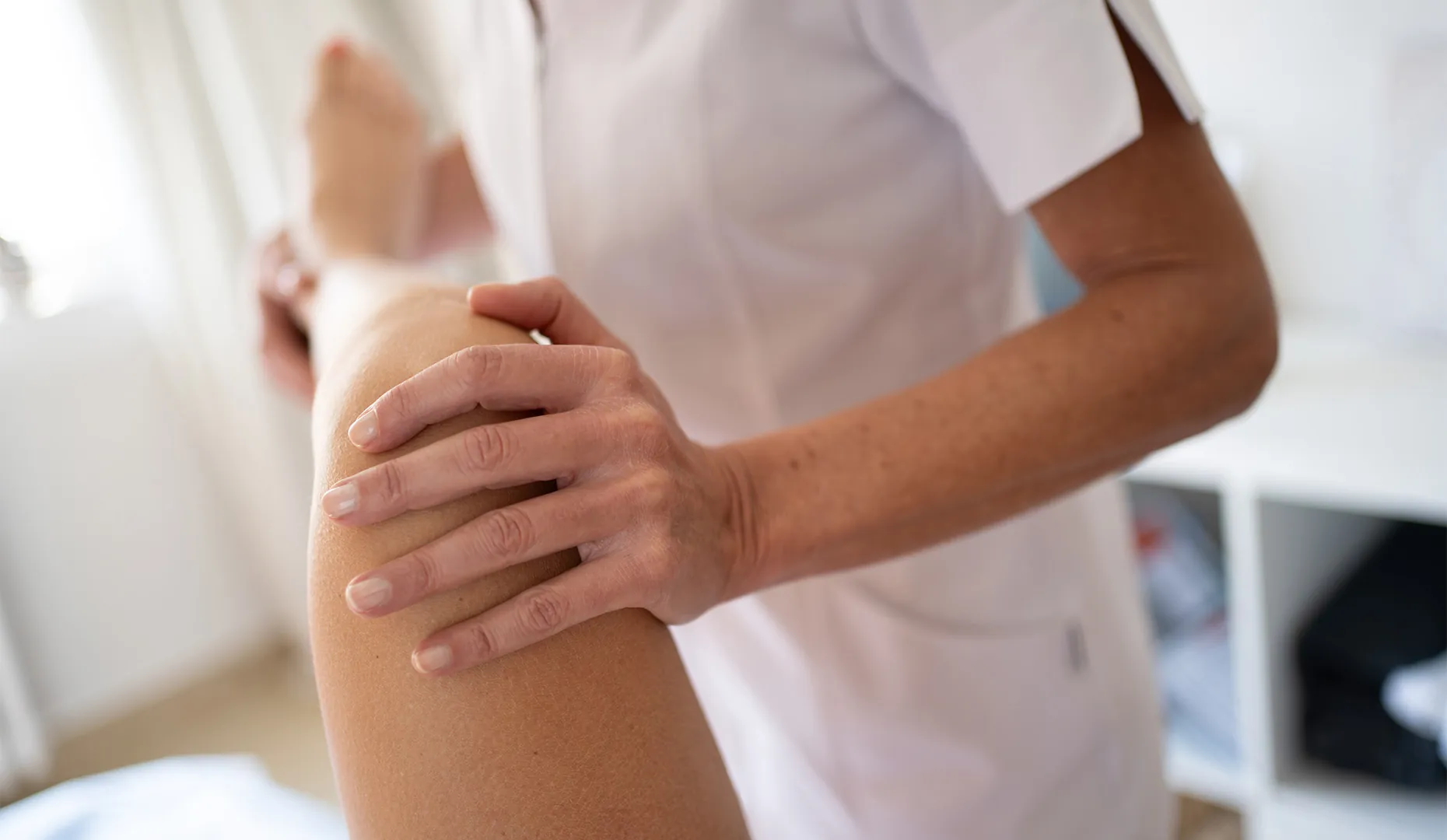
An injury to your Anterior Cruciate Ligament (ACL) can be a painful and disruptive experience, making daily life significantly harder to navigate.
You might feel a deep, nagging ache within the joint, an unsettling sensation of your knee ‘giving way’ when you put weight on it, or a frustrating stiffness that prevents you from fully bending or straightening your leg.
If you have an ACL injury, it’s important to seek physiotherapy to prevent further damage and ensure a full recovery.
In this guide, we walk through each phase of a typical post-operative ACL treatment, so you know exactly what to expect on your journey.
Phase 1: Early Recovery (Weeks 1-2)
In the early days of your recovery, your body needs one thing above all: a chance to rest. Your focus should be on managing the initial symptoms and laying the foundation of your recovery.
- Control Pain and Swelling
Your main priority is to use icing, compression, and elevation to reduce swelling and create the best environment for healing to begin.
- Gentle Muscle Activation
Once the swelling starts to subside, your physiotherapist will introduce exercises to prevent your knee from getting stiff and reactivate your muscles.
- Introduce Gentle Movement
xpect to start with simple movements like heel slides to encourage bending and quad sets to reactivate the muscles that protect your knee.
Phase 2: Mid-Stage Rehabilitation (Weeks 3-6)
This crucial stage is about actively rebuilding your knee’s strength, endurance, and control.
- Build Foundational Strength
After an ACL injury, the surrounding muscles, especially your quadriceps, weaken significantly. That’s why your primary goal is to build them back up for stability and improved blood flow. Your physiotherapist will progress you to controlled, low-impact exercises like mini-squats, leg presses, and hamstring curls.
- Improve Balance and Control
Alongside building strength, you’ll work on regaining your balance through exercises like standing on one leg and single-leg Romanian deadlift (RDL). This dual focus on both strength and stability is key to rebuilding confidence and control over your injured knee.
Phase 3: Advanced Rehabilitation (Months 2-4)
By this point in your journey, the constant pain has likely faded, and your knee feels much more like your own again. This phase focuses on building power and relearning to trust your knee’s ability to handle more grueling tasks.
- Advanced Strengthening
Your physiotherapist will challenge you with more dynamic, full-range movements, often adding weight to build strength. You’ll move beyond the basics and start incorporating exercises like deep squats, walking lunges, and step-ups. - Return to Running
This solid base of strength allows you to enter the exciting stage of reintroducing more dynamic activities, starting with a return-to-running program designed to ease you back into it safely.
- Learn to Land Safely
You’ll begin basic plyometrics, using controlled explosive movements like box jumps to teach your body how to safely absorb impact and land softly.
Phase 4: Preparing for Sport (Months 5-9)
The good news is, you’re in a stronger position now. You’ve built a substantial foundation of muscle and your knee feels stable and moves freely. Now the goal is to find the balance between rehabilitation and training like an athlete again.
To do this, your training will focus on three key areas:
- Prepare for Unpredictability
While strength training remains a key part of your ACL treatment, the focus is now on preparing your knee for the unpredictable demands of your sport.
- Master Agility and Cutting
Since most ACL injuries occur during an abrupt stop or change of direction, your training will directly target these high-risk movements to build resilience.
- Develop Sport-Specific Skills
You’ll work with your physiotherapist on high-level agility drills, reactive drills, and advanced plyometrics so that you can build the confidence you need before returning to the game.
Phase 5: Safe Return to Sport (Months 9-12)
This is where all your hard work and consistency pays off. However, the criteria about return to sport isn’t only about time, but tests to confirm that you can return safely to sport. Going back to your sport after an ACL injury is daunting, but you can overcome the final hurdle with a smart, gradual approach. The key is to integrate yourself in stages, not all at once.
This process involves:
- Rejoining team practices for non-contact drills
- Progressing to controlled, game-like practice situations against teammates
- Starting with limited minutes in games, and slowly increasing your playing time based on how your knee responds.
Important Precautions Throughout Your Recovery
It’s not just about performing these exercises regularly. It’s just as important to develop a resilient mindset and daily habits to prevent further injury.
Here are key precautions to take throughout your recovery:
- Take your time
Your ACL tear treatment is unique to you. That means your time of recovery will depend on your body’s healing, strength gains, and functional testing.
- Listen to Your Body
It’s natural to want to speed up your recovery by doing more, but any indication of sharp pain is a signal to stop and consult your physiotherapist.
- Focus on Consistency
Skipping sessions or being inconsistent with your exercise program will hinder your progress more than you think. The small, daily efforts are what build a strong, stable knee.
- Quality over Quantity
Focus on your form. Ten repetitions with perfect technique is far more beneficial than twenty with bad technique. Poor form can put unnecessary stress on your healing ligament and build bad movement patterns.
- Trust Your Physiotherapist
Your physiotherapist is there to help you. Be honest with them about your symptoms, your fears, and your goals. They will tailor your program and tell you when it’s safe to progress to the next step.
Book Your Appointment at Bangkok Physiotherapy Center
An ACL injury doesn’t have to dictate your life or keep you from the sport you love. With the right treatment and support, a full range of motion and a resilient, pain-free knee are achievable goals.
At Bangkok Physiotherapy Center, our expert physiotherapists understand the physical and emotional toll an injury takes. We are dedicated to providing the specialized care you need to get back on your feet. Contact us to schedule your appointment and take the first, most important step for your knee health.